




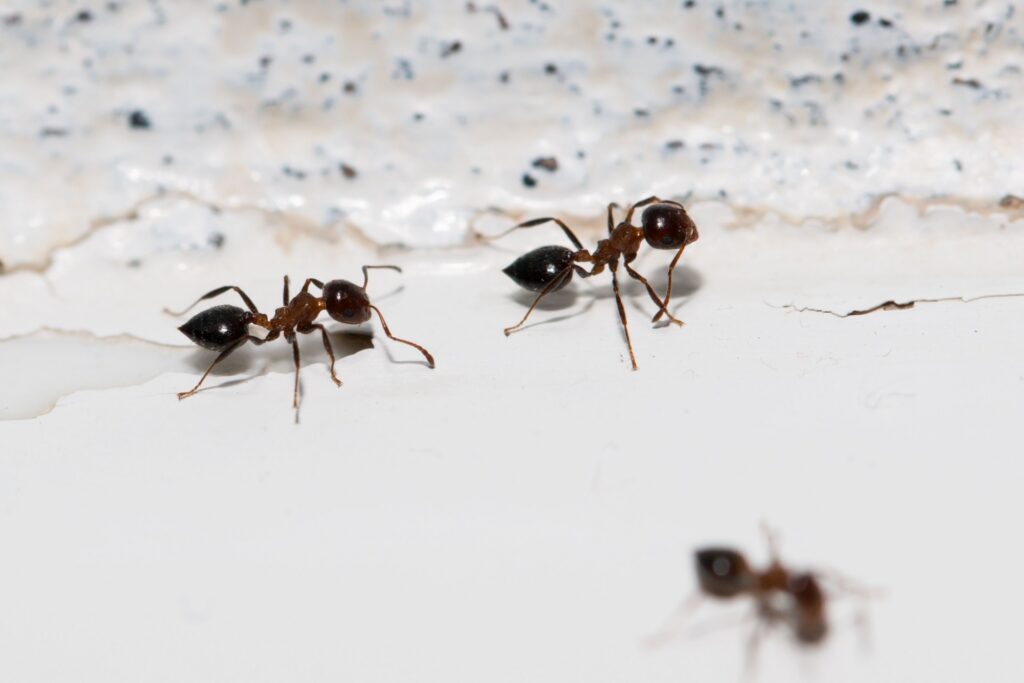
Ant trails inside a Las Vegas home can seem to appear out of nowhere. One day the house is clear, and the next there is a line of ants marching across the kitchen floor or bathroom wall. The reality is that ants do not appear randomly. They follow specific routes, exploit specific entry points, and are drawn by specific conditions. Knowing how ants get into desert homes makes it easier to understand why they keep coming back—and what it takes to stop them. Prime Pest Control treats ant infestations at the source, sealing off the pathways that give ants access to your home.
Foundation Cracks and Expansion Joints
The most common entry point for ants in Las Vegas homes is the foundation. Concrete slab foundations develop small cracks over time due to soil settling, temperature fluctuations, and the natural curing process. Expansion joints—the intentional gaps between sections of concrete—also provide direct access from the soil beneath the slab to the interior of the home.
Ants are small enough to pass through gaps that are barely visible to the homeowner. A crack that appears insignificant from above may be a well-traveled highway for thousands of foragers below. Ants frequently emerge through these cracks in areas where the slab meets interior walls, around the base of kitchen islands, and near bathroom fixtures that sit directly on the slab.
Utility Penetrations
Every home has multiple points where plumbing pipes, electrical conduit, gas lines, and communication cables pass through exterior walls or the foundation. These penetrations are rarely sealed completely. Small gaps around pipe collars, wire entry points, and conduit openings provide direct pathways from the exterior into wall voids, under cabinets, and behind appliances.
In the desert, the soil along a home’s foundation is one of the most actively foraged areas for ants because it collects moisture from irrigation and remains shaded for much of the day. Utility penetrations in this zone give foragers a straight path inside.
Doors and Windows
Gaps beneath exterior doors are one of the most straightforward entry points, especially on ground-floor doors that open to patios, garages, or landscaped areas. Weatherstripping wears down over time, and even a small gap beneath a door is enough for ants to pass through single file.
Window frames—particularly on the ground floor—can also allow entry where the frame meets the wall or where caulking has cracked or pulled away. Sliding glass doors are a common problem area because the tracks collect debris and the seals along the bottom edge deteriorate with use.
Weep Holes in Brick and Block
Many homes in the Henderson and Las Vegas area have decorative brick or block walls on the exterior. Weep holes—small openings at the base of the wall designed to allow moisture to drain—also allow ants to enter the wall cavity and travel upward into the home. Block walls along property lines are one of the most common nesting sites for ant colonies in the desert, and these walls often connect to or sit directly adjacent to the home’s exterior walls.
Landscaping and Irrigation Lines
Ants frequently follow irrigation tubing and drip lines that run along or under the foundation. These lines carry moisture directly to the areas where ants are most active, and the tubing itself provides a protected pathway. Plants, mulch, or rock landscaping that sits against the foundation creates additional harborage and nesting opportunities within inches of the home.
Trees and shrubs with branches touching the roof or exterior walls can also serve as bridges, allowing ants to bypass ground-level barriers and enter through upper-story gaps, attic vents, or roof-to-wall transitions.
Garage Floors and Attached Structures
Garage slabs often have larger expansion joints and more cracks than the main living area slab. Garages also tend to have larger gaps beneath the main door and around the door frames connecting to the home’s interior. Ants that enter the garage have easy access to the rest of the house through these interior connections, which is why many homeowners first notice ant activity near the garage entry or in rooms adjacent to the garage.
Sealing Entry Points Is Part of the Solution
Caulking cracks, replacing worn weatherstripping, and sealing around utility penetrations can close off specific routes. But because ants are persistent and capable of finding alternative paths, sealing works best as part of a broader treatment plan that includes perimeter barriers and colony-level baiting. Contact Prime Pest Control to schedule an inspection that identifies the entry points and nesting sites specific to your property, and get a treatment plan that addresses both.