



Ant control in Las Vegas requires a different approach than it does in most other parts of the country. The combination of extreme heat, irrigated desert landscaping, sandy soil, and year-round warm temperatures creates conditions where ant colonies grow large, nest deep, and forage aggressively—especially around homes. This guide covers what Las Vegas homeowners need to know about treating and preventing ant infestations, from identifying the problem to choosing the right ant control service for the job.
Understanding Why Ants Are So Persistent Here
Ants in the Las Vegas Valley are not seasonal pests that disappear when the weather changes. Warm temperatures throughout most of the year keep colonies active and foraging nearly nonstop. The desert itself lacks natural food and water, so ants concentrate their activity around residential properties where irrigation, landscaping, and household waste provide everything they need. A single colony can contain tens of thousands of workers, and some species form multi-queen colonies that are especially difficult to eliminate without professional treatment.
Step One: Identify the Species
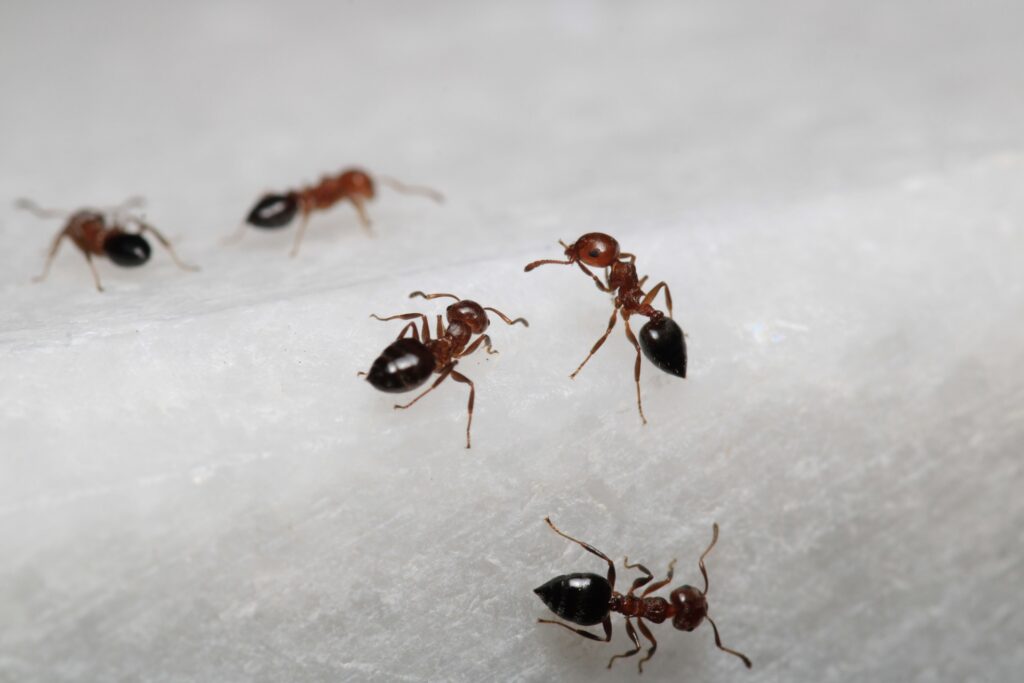
Not all ants respond to the same treatment. Argentine ants, odorous house ants, fire ants, carpenter ants, and pavement ants are all common in the valley, and each one nests, forages, and reproduces differently. Baiting strategies that work on sugar-feeding species may be ineffective against grease-feeding species. Spraying a colony entrance can cause some species to scatter and establish new nesting sites—a process called budding—which makes the problem worse rather than better.
A professional inspection starts by identifying the species, which determines the treatment plan.
Step Two: Locate the Colony
Killing visible ants on a countertop or along a baseboard does not solve the problem. The colony—including the queen—is almost always located somewhere else entirely. In Las Vegas, common nesting locations include the soil beneath rock landscaping, inside block wall cavities, under concrete slabs, inside wall voids near plumbing, and deep underground along irrigation lines.
Locating the colony requires tracing foraging trails back to their source and inspecting the areas around the home where nesting conditions are most favorable. This is one of the most important steps in effective ant control, and it is also one of the most commonly skipped in DIY attempts.
Step Three: Treat the Colony, Not Just the Trails
Effective ant treatment targets the colony itself. This typically involves a combination of methods.
- Baiting systems use slow-acting products that foraging ants carry back to the colony and share with other workers and the queen. Over time, the bait eliminates the colony from the inside.
- Perimeter barrier treatments create a treated zone around the foundation that intercepts foragers before they enter the home. Prime Pest Control’s Triple D-Fence approach includes a 3×3 foot power spray barrier around the home’s foundation as part of this process.
- Crack and crevice treatments target specific entry points where ants are entering the home, such as gaps around pipes, door frames, and window sills.
- Wall injection addresses colonies that have established nests inside wall voids or other enclosed spaces within the structure.
The specific combination depends on the species, the severity of the infestation, and the layout of the property.
Step Four: Address the Conditions That Attracted Ants
Treatment alone will produce temporary results if the conditions that attracted ants in the first place remain unchanged. In Las Vegas, the most common attractants include excess moisture from irrigation, standing water in plant saucers and drainage areas, food residue in kitchens and pantries, pet food left out overnight, and vegetation or debris piled against the foundation.
Reducing these attractants does not guarantee ants will stay away – colony networks in the desert are large and persistent – but it significantly reduces the pressure on treated areas and extends the effectiveness of professional treatments.
Step Five: Maintain Ongoing Protection
Because of the year-round activity cycle and the scale of colony networks in the desert, one-time ant treatments often provide only short-term relief. Bi-monthly or quarterly service visits allow a technician to re-treat the perimeter, monitor for new activity, and address emerging problems before they become full infestations. Prime Pest Control’s membership plans include scheduled service visits and between-visit callbacks at no additional cost if ants return.
When to Call a Professional
If you are seeing ants daily, finding trails in multiple rooms, or dealing with ants that return within days of cleaning or spraying, the colony is established and active enough that professional treatment is the most effective path forward. Contact Prime Pest Control to schedule an inspection and get a treatment plan built for the specific conditions on your property.