



Henderson homeowners deal with ants more than almost any other household pest. The desert climate, irrigated landscaping, and block wall construction across the valley create conditions where multiple ant species thrive year-round. Knowing which species you are dealing with matters because each one behaves differently, nests in different locations, and responds to different treatment methods. If you are already seeing ant activity inside your home, Prime Pest Control’s ant control services in Henderson can help identify the species and eliminate the colony at its source.
Argentine Ants
Argentine ants are one of the most widespread ant species in the Las Vegas Valley. They are small, typically about 1/16 to 1/4 inch long, and are uniform light to dark brown in color. These ants travel in wide, well-defined trails that are easy to spot along sidewalks, foundation edges, and irrigation lines.
What makes Argentine ants particularly difficult to manage is their colony structure. A single colony can contain multiple queens, and colonies frequently merge with neighboring colonies rather than competing with them. This means infestations can grow quickly and spread across an entire property or even a neighborhood. They are strongly attracted to moisture, which is why Henderson homes with drip irrigation, leaky hose bibs, or overwatered landscaping tend to see the most activity.
Odorous House Ants
Odorous house ants are another frequent invader in Henderson kitchens and bathrooms. They are small—roughly 1/16 to 1/8 inch—and dark brown to black. The easiest way to identify them is by smell. When crushed, they release a distinct odor that is often described as similar to rotten coconut.
These ants nest in a wide range of locations, including wall voids, beneath flooring, under rocks in landscaping, and inside potted plants. They are especially active during hot summer months when outdoor conditions drive them toward the cooler, moister environment inside a home. Odorous house ants are generalist foragers and will eat sweets, grease, and proteins, which makes kitchens a primary target.
Southern Fire Ants
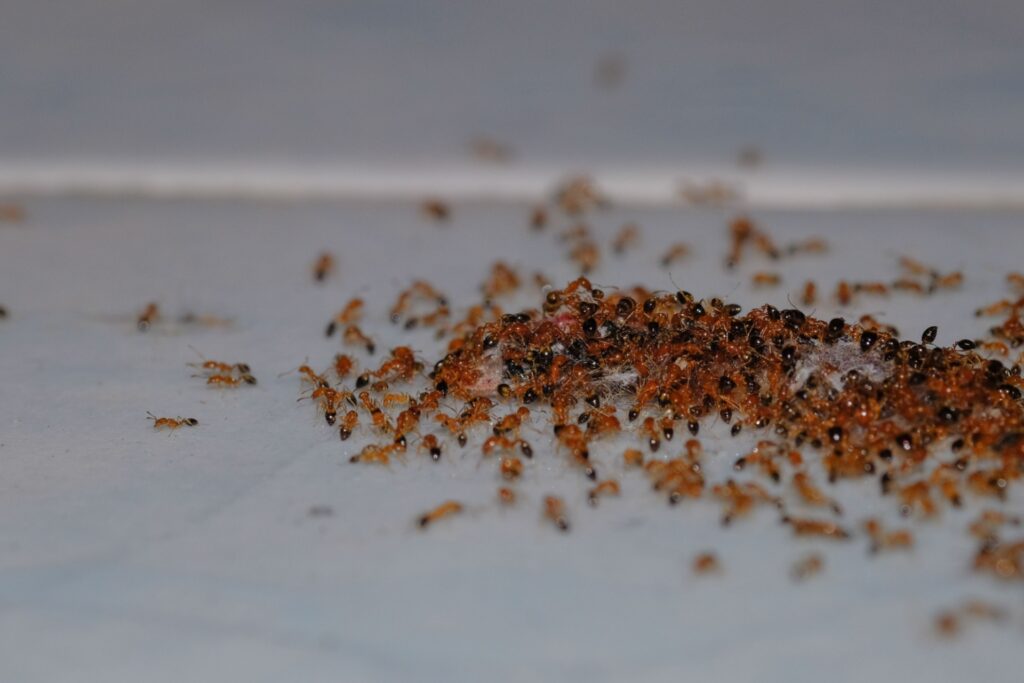
Southern fire ants are present throughout the Las Vegas metro area and are easily identified by their reddish-brown color and aggressive behavior. They range from about 1/8 to 1/4 inch in length. Fire ants build visible mound-shaped nests in soil, often in yards, garden beds, and along sidewalks or driveways.
Fire ants sting when disturbed, and the sting produces a burning sensation followed by a raised welt that can last for days. For individuals with allergies, fire ant stings can cause more serious reactions. Because of the health risk, fire ant colonies should be treated professionally rather than disturbed with DIY methods, which can scatter the colony and make the problem worse.
Carpenter Ants
Carpenter ants are among the larger ant species found in Henderson, ranging from 1/4 to 1/2 inch long. They are typically black, though some species may appear dark red or a combination of both. Unlike termites, carpenter ants do not eat wood. Instead, they excavate galleries inside wood to build their nests, leaving behind small piles of fine sawdust-like shavings called frass.
In the desert, carpenter ants are most often found in wood that has been softened by moisture—around leaky windows, damaged roof eaves, or wood that contacts irrigated soil. Because the structural damage they cause can go unnoticed for months, early identification is important.
Pavement Ants
Pavement ants are common in Henderson neighborhoods with concrete driveways, patios, and sidewalks. They are small (about 1/8 inch), dark brown to black, and are best identified by the small mounds of displaced sand or soil that appear in cracks between pavement sections, along expansion joints, and at the edges of garage slabs.
Pavement ants forage for a wide range of foods and frequently enter homes through foundation cracks and gaps around ground-level doors. They are not aggressive and do not cause structural damage, but their colonies can be large and persistent.
Why Identification Matters for Treatment
Each of these species responds differently to treatment. Baiting works well for species like Argentine ants and odorous house ants, where foragers carry product back to the colony. Fire ants often require direct mound treatment. Carpenter ants require locating and treating the nesting site inside the affected wood. Using the wrong approach – or a generic over-the-counter spray – can scatter a colony, cause it to split, or simply kill the visible ants without reaching the queen.
A professional inspection identifies the species, locates nesting sites, and determines the best treatment strategy for the specific situation. Contact Prime Pest Control to schedule an inspection and get a treatment plan tailored to the ant species on your property.